Intellectual Real Estate: How Foreign Billions Bought the Ivy League
In the real estate business, there is a fundamental truth we all understand: whoever controls the land, controls the asset’s future. Location, structural footprint, and zoning dictate everything. But over the past two decades, a quiet, multi-billion-dollar transaction has taken place that redefines the concept of property acquisition. Middle Eastern nations—led predominantly by Qatar, Saudi Arabia, and the United Arab Emirates (UAE)—have poured staggering sums of money into elite U.S. universities.
Intellectual Real Estate
This isn’t standard philanthropy or passive charity; it is a highly calculated exercise in asset acquisition. In our industry, we call it institutional capture. While these Gulf states have historically maintained tight restrictions on foreign private property ownership within their own borders, they have aggressively purchased the ultimate “intellectual real estate” in America. What many people fail to realize, however, is that this institutional buyout mirrors a literal, physical land rush occurring right under our noses on American soil.
Take my home state of Arizona as a prime example. For years, Saudi and Emirati agribusiness conglomerates have quietly bought and leased thousands of acres of Arizona desert land. Leveraging our historically lax groundwater regulations, they drilled deep, unregulated commercial wells to pump millions of gallons of water out of ancient, depleting desert aquifers. They used this precious water to cultivate alfalfa and cotton—incredibly water-intensive crops that have no business being grown in a drought-stricken desert. The harvested crops were then baled and shipped directly back to the Middle East to feed their own livestock. In essence, they successfully exported Arizona’s water supply, causing local domestic wells to run dry and forcing the State of Arizona and local regulators into an aggressive legal battle to strip these foreign mega-farms of their unrestricted pumping rights.
The True Cost of “Thirsty” Crops in the Desert
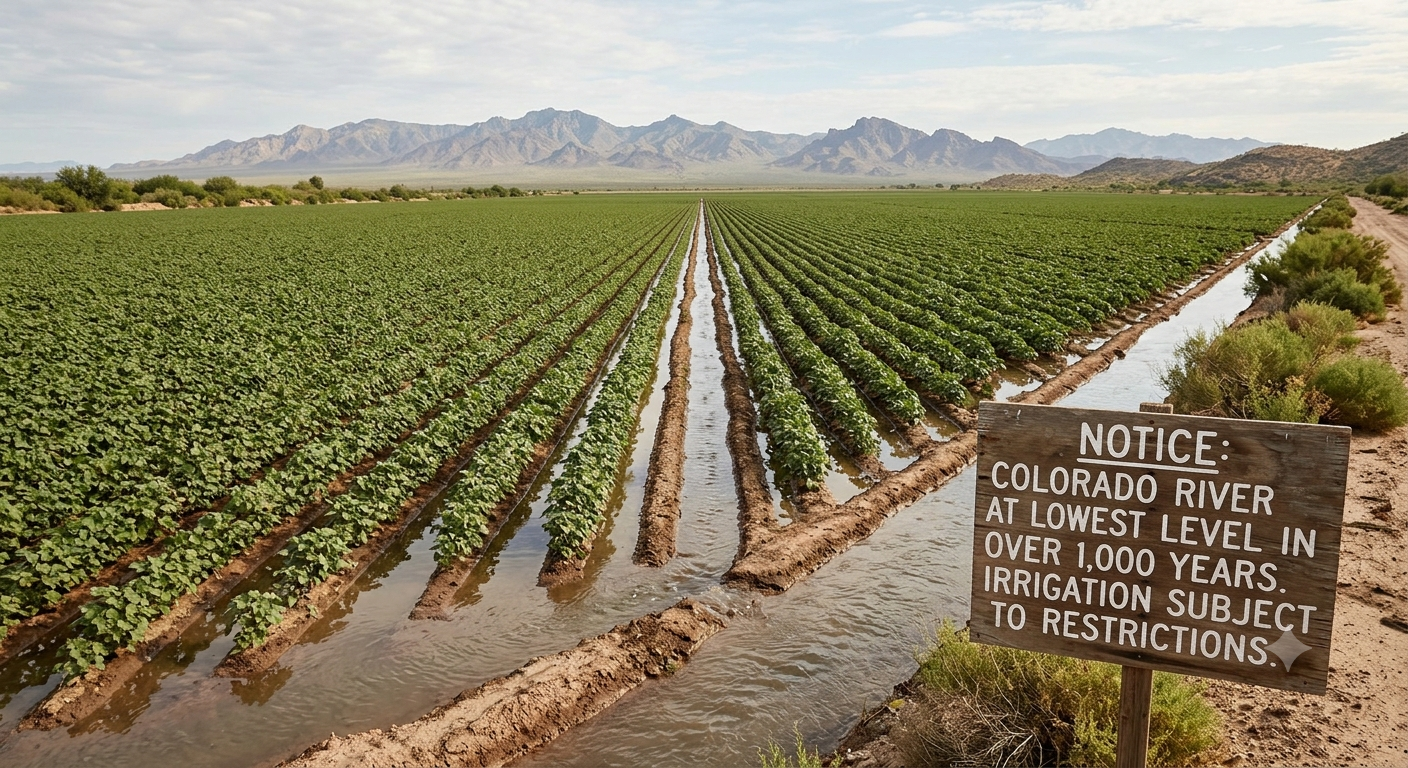
Effectively exporting Arizona’s most precious resource right out from under its residents.
When evaluating agricultural land use and water rights in Arizona, the conversation often revolves around one metric: the “acre-foot.” An acre-foot is the volume of water it takes to cover one acre of land in one foot of water, which equals roughly 325,851 gallons.
Traditional commodity crops like alfalfa and cotton are historically ingrained in Arizona’s agriculture, but they are incredibly water-intensive. Alfalfa, which is heavily favored by foreign-owned corporate farms to feed livestock overseas, can consume up to 6.2 acre-feet of water annually. Cotton requires approximately 4.2 to 5.5 acre-feet per year.
By contrast, forward-thinking farmers and researchers are turning to drought-adapted alternatives. For example, Guayule—a native desert shrub used to produce natural rubber—uses less than half the water of cotton or alfalfa, thrives in the arid climate, and doesn’t die if watering is delayed. Similarly, switching to seasonal winter vegetables, which grow during cooler months with much lower evaporation rates, drastically reduces overall water demands.
Arizona Crop Water Usage Comparison
Here is how the water requirements stack up per acre:
| Crop Type | Average Water Used (Acre-Feet per Year) | Climate Suitability & Notes |
| Alfalfa | 6.0 – 6.2 | Very High Water Need. Grown year-round for domestic and foreign livestock feed. |
| Cotton | 4.2 – 5.5 | High Water Need. Traditional cash crop requiring heavy summer irrigation. |
| Corn | 4.0 – 4.5 | High Water Need. Highly evaporative during the intense summer months. |
| Guayule (Rubber Shrub) | 2.5 | Drought-Resistant. Native desert plant requiring minimal water that survives extended dry spells. |
| Winter Vegetables (e.g., Lettuce) | ~0.7 (approx. 8.5 inches) | Water-Efficient. Grown during cooler months to avoid peak summer evaporation. |
This isn’t an isolated regional anomaly, either. A recent Government Accountability Office (GAO) report highlighted that foreign entities now hold financial interests in over 40 million acres of U.S. agricultural land. Even more alarming for national security watchdogs is the strategic location of some of these purchases: foreign buyers have increasingly targeted farmland, ranches, and commercial property sitting in close, sensitive proximity to vital U.S. military bases, such as the high-profile attempt by a Chinese firm to secure land near a drone-technology Air Force base in North Dakota.
Whether we are talking about physical acreage or academic infrastructure, the strategy remains entirely identical. By funding the premier pipelines of American leadership, these foreign governments have successfully bought the classrooms, curated the faculty, and subtly molded the minds of the next generation of American lawmakers, diplomats, journalists, and corporate executives.
The Scale of the Transaction
When evaluating any portfolio, you have to look at the hard data. While tracking foreign influence on college campuses has historically been difficult due to widespread university non-compliance, federal disclosures and recent transparency audits have exposed the sheer volume of wealth flowing into higher education.
Aggregate data from the U.S. Department of Education’s foreign funding database reveals that Arab nations have funneled over $14.6 billion to $16.2 billion into U.S. higher education, with the vast majority of it arriving over the last fifteen years.
The primary entities driving this capital injection include:
Qatar: The undisputed heavyweight of foreign academic funding, having single-handedly donated more than $7.7 billion. Qatar is the largest single foreign funder of U.S. universities on the planet, easily outpacing economic superpowers like China.
Saudi Arabia: Follows as the second-largest Middle Eastern donor, contributing between $3.9 billion and $4.2 billion.
The United Arab Emirates (UAE): Has injected roughly $1.7 billion to $1.8 billion into the system.
The primary beneficiaries of this capital are not small, struggling colleges; they are America’s most prestigious “trophy properties”—our elite Ivy League institutions. Cornell University leads all American schools (receiving over $2.3 billion), followed closely by Carnegie Mellon University, Georgetown University, Northwestern University, Harvard, and Texas A&M.
Buying the Infrastructure: Endowed Chairs as Permanent Leases
In commercial real estate, writing a generic check gives a donor zero control over building operations. The Gulf states understood this dynamic perfectly. Therefore, their financial strategy was designed to buy a permanent structural footprint within these universities. They achieved this through two primary vehicles: endowed faculty chairs and dedicated academic centers.
Think of an endowed chair as a permanent, lifetime lease on a professor’s podium. A donor provides a multi-million-dollar fund to permanently pay the salary and research budget of a professor. Similarly, funding an entire “Center for Middle Eastern Studies” establishes a self-governing silo within the university.
Georgetown University: Qatar has directed over $1 billion to Georgetown, heavily funding the Prince Alwaleed Bin Talal Center for Muslim-Christian Understanding and the Center for Contemporary Arab Studies. These centers dictate their own faculty recruitment, research priorities, and curriculum.
The Ivy League Footprint: Across Harvard, Columbia, and other elite institutions, Saudi and Emirati royals have systematically funded permanent chairs in Islamic Law, Islamic History, and contemporary Middle Eastern politics.
The mechanics of this arrangement are highly effective. A university administration will naturally avoid hiring or retaining professors whose scholarship or public statements actively criticize their multi-billion-dollar foreign donors. Consequently, the departments that teach American students about Middle Eastern culture, history, and foreign policy are staffed by faculty whose worldviews naturally align with the regimes funding their salaries.
The Subtlety of “Mind Molding”
The true brilliance of this strategy lies in its subtlety. This is an exercise in Soft Power—the geopolitical ability to shape the preferences and worldviews of others through attraction and institutional filtering rather than coercion.
To a brilliant 19-year-old student sitting in an Ivy League classroom, the professor at the podium is the ultimate academic authority. The student has no reason to suspect that the syllabus, the selected textbooks, and the framing of historical events have been carefully curated over decades of financial backing.
This institutional capture alters the academic ecosystem in several distinct ways:
Sanitizing the Narrative: Within these heavily funded departments, systemic human rights abuses, regional aggression, or religious extremism within the donor countries are routinely minimized, contextualized, or entirely omitted from the curriculum.
Creating a Self-Enforcing Echo Chamber: By dominating the academic narrative, the environment becomes one where the donor country’s perspective is treated as the baseline truth. Anyone attempting to challenge the narrative is often framed as uneducated or intolerant by their own peers and professors, stifling legitimate debate.
The Long-Term Policy Pipeline: Students do not remain in the classroom forever. Ten, fifteen, or twenty years down the road, these graduates ascend into critical positions within the State Department, national intelligence agencies, mainstream media networks, and major international corporations. When a critical foreign policy decision or a major news story breaks regarding the Middle East, their foundational baseline has already been shaped by an education bought and paid for by foreign interests.
The Corporate Veil: The Transparency Crisis
For any business professional, the most alarming aspect of this multi-billion-dollar flow of capital is the deliberate lack of transparency. Section 117 of the Higher Education Act legally requires American universities to disclose all foreign gifts and contracts exceeding $250,000. However, federal compliance reviews have revealed a massive, systematic failure by universities to accurately report where this money goes.
An analysis of federal databases shows that nearly 70% to 75% of the total billions flowing from Arab nations is listed with “no stated purpose” or completely blank descriptions. Billions of dollars are entering the American university system with entirely hidden terms, conditions, and operational mandates.
Furthermore, a significant portion of this money funds massive “satellite campuses” in Doha, Qatar—known as Education City. Elite institutions like Cornell (Medicine), Northwestern (Journalism), and Georgetown (Foreign Service) operate fully functional campuses funded entirely by the Qatari government. Contracts uncovered by legal watchdogs have shown that these agreements often legally restrict faculty and students on these satellite campuses from criticizing the host regime, effectively trading traditional American academic freedom for foreign capital.
Conclusion: The Dividends of Institutional Capture
The Gulf states executed a masterful, multi-decade strategy. They recognized that attempting to lobby established, adult politicians in Washington is an expensive, short-term fix. Instead, they realized it is far more permanent and effective to buy the classrooms and mold the minds of the young people who will become the politicians, journalists, and cultural leaders.
For years, this looked like a quiet, academic exercise. But today, the dividends of that long-term investment are spilling out of the classrooms and onto the campus quadrangles in stark, unmistakable terms.
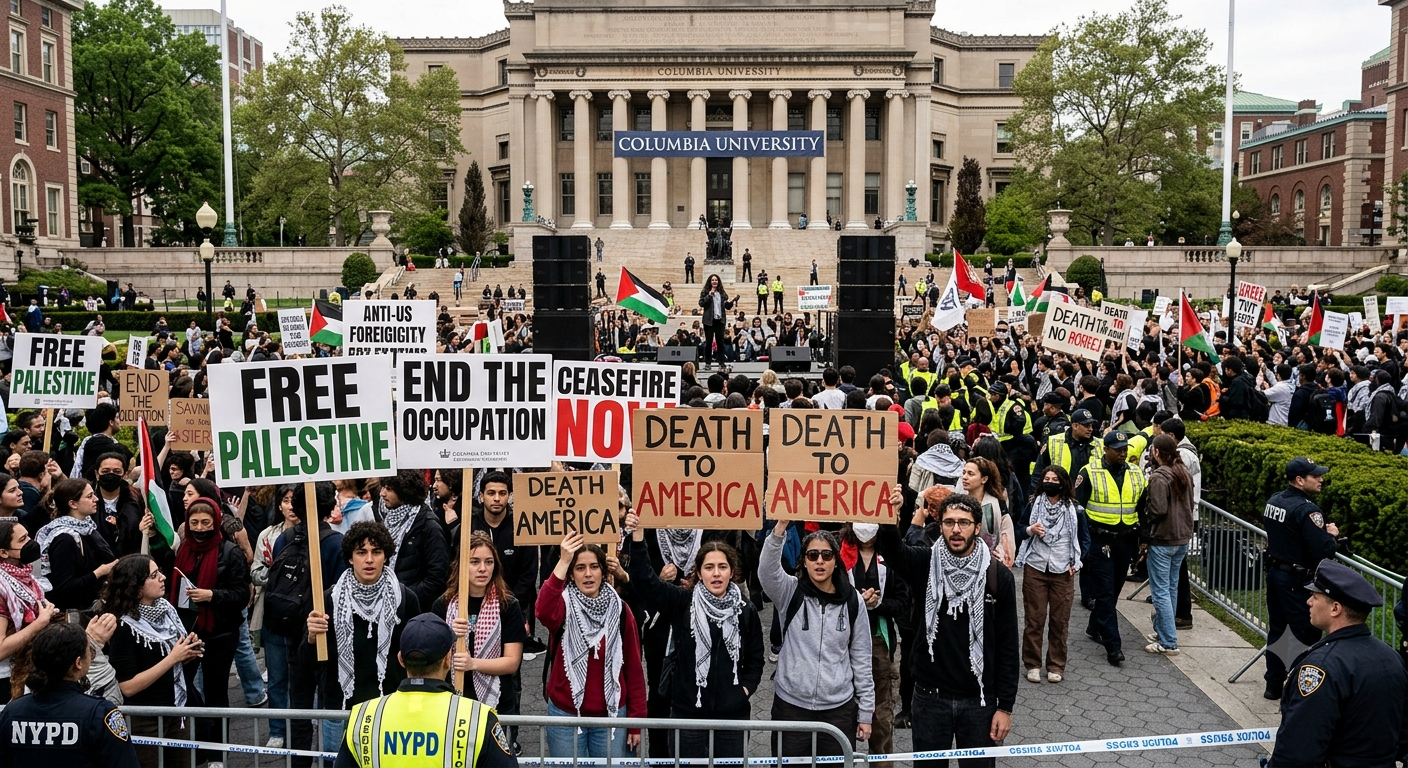
The aggressive, highly coordinated pro-Palestinian protest movements that recently paralyzed elite institutions—most notably the chaotic encampments that seized Columbia University in New York City—are the direct radical manifestations of this ideological shift. When we see American students at premier universities openly echoing the propaganda of foreign militant groups, defacing campus property, and, in some extreme instances, chanting “Death to America,” we are no longer looking at organic, grassroots student activism. We are looking at the finished product of a multi-billion-dollar, foreign-funded curriculum designed to alienate America’s brightest youth from their own country’s values, heritage, and strategic alliances.
By utilizing their immense wealth to purchase prestige by association and embed themselves into the administrative fabric of elite higher education, these foreign nations did not just buy buildings and fund research. They successfully imported a foreign geopolitical agenda, weaponized the American tradition of academic freedom against itself, and altered the intellectual and moral baseline of America’s future leadership class from the inside out. In real estate, we say location is everything. In global geopolitics, it turns out that controlling the location of the classroom—just like controlling the location of our farmland—changes the world.
For those interested in how these sovereign dynamics play out symmetrically on foreign soil, this broadcast breaks down Saudi Arabia’s newly implemented laws regarding foreign real estate investment, highlighting the strict boundaries they maintain at home while expanding their financial influence abroad.
Intellectual Real Estate
#######
Brokerforyou.com is for SALE
- Just like most major businesses, the easiest way, and the fastest way to expand your business and influence in your particular market is through strategic acquisition. Just look at Google, they are the number one search engine in the world! Google bought Youtube in November 2006 for US$1.65 billion! YouTube now operates as one of Google’s subsidiaries.www.brokerforyou.com is for sale and is offered with a very popular San Diego residential real estate channel with 1.16K subscribers and 114 videos!!What’s the approximately monthly cost to host a website? With shared hosting, you’re hosting fee can break down to about 10 to $15 per month. To keep your url registered (that’s your site address), this is usually paid on a five to 10-year basis, which averages out to about just a dollar per month! Naturally, if you add direct hook-up to a MLS database, that provides lead capturing, this costs can vary greatly from provider-to-provider.
- Also available, much smaller aged websites (not just urls) for Real Estate agents and brokers in California. Yes, since I’m retired from Real Estate now I have a number of websites that are available that you can use for readings to your main site. The following real estate area sites are available but subject to prior sale, without notice: San Diego, downtown San Diego, Del Mar, Encinitas, Orange County, and Los Angeles. If you’d like to purchase any of these sites with all the content included, you can get them at a Bargain Basement price. Please contact me if you’d like further details.
- Interested: seo711@gmail.com for additional information
Looking for a real unique gift/Investment?
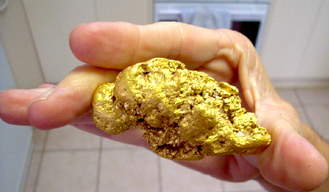
Natural gold nuggets

Natural gold nugget Visit our California & Arizona gold prospecting site.
+++++++++++++
Great 360 Camera – This is the one that I use not only for real estate but motorcycling & gold prospecting.
Direct from the manufacturer w/ Free shipping, special bonus accessory & even tax included.
Click camera photo below for more details and to see actual 360 video & photos taken with this amazing marvel, direct from manufacturer . . .

- insta360 One X3
++++++++
DISCLAIMER:
- Some of the links in this content and in our videos may be affiliate links, and pay a small commission if you use them, but never increase the basic cost. I really appreciate the support. This content & my Youtube videos SHALL NOT be construed as tax, legal, insurance, construction, engineering, health & safety, electrical, financial advice, or other & may be outdated or inaccurate; it is your responsibility to verify all information. I am a not financial adviser. I only express my opinions based on my experiences. Your experience may be quite different. Investing of any kind involves risk. While it is possible to minimize risk, your investments are solely your responsibility. You must conduct your own research. There is NO guarantee of gains or losses on any investments. My produced content & videos are for entertainment purposes ONLY. DO NOT make buying or selling decisions based on these videos. If you need advice, please contact a qualified CPA, attorney, insurance agent, contractor/electrician/engineer, financial advisor, or the appropriate professional for the subject you would like help with.
- Although no longer a licensed California real estate broker Bob’s 30 plus years of experience in the real estate industry with all the contacts that he has developed, he is able to provide referrals to the top real estate Professionals in any state within the United States. So, although you can’t get Bob to represent you personally, Bob can select a top real estate professional with years and years of experience to ensure that you get the best possible representation.