The California Creative Writing Club: How “Pothole Repair” Pays for the Train to Nowhere (and What’s Next)
If you want to understand how California became the first state in the nation to build the infrastructure for a taxpayer-funded reparations system—despite entering the Union as a free state in 1850—you first have to understand the Golden State’s favorite legislative parlor trick: The Masterfully Misnamed Bill.
Pothole Repair Train to Nowhere
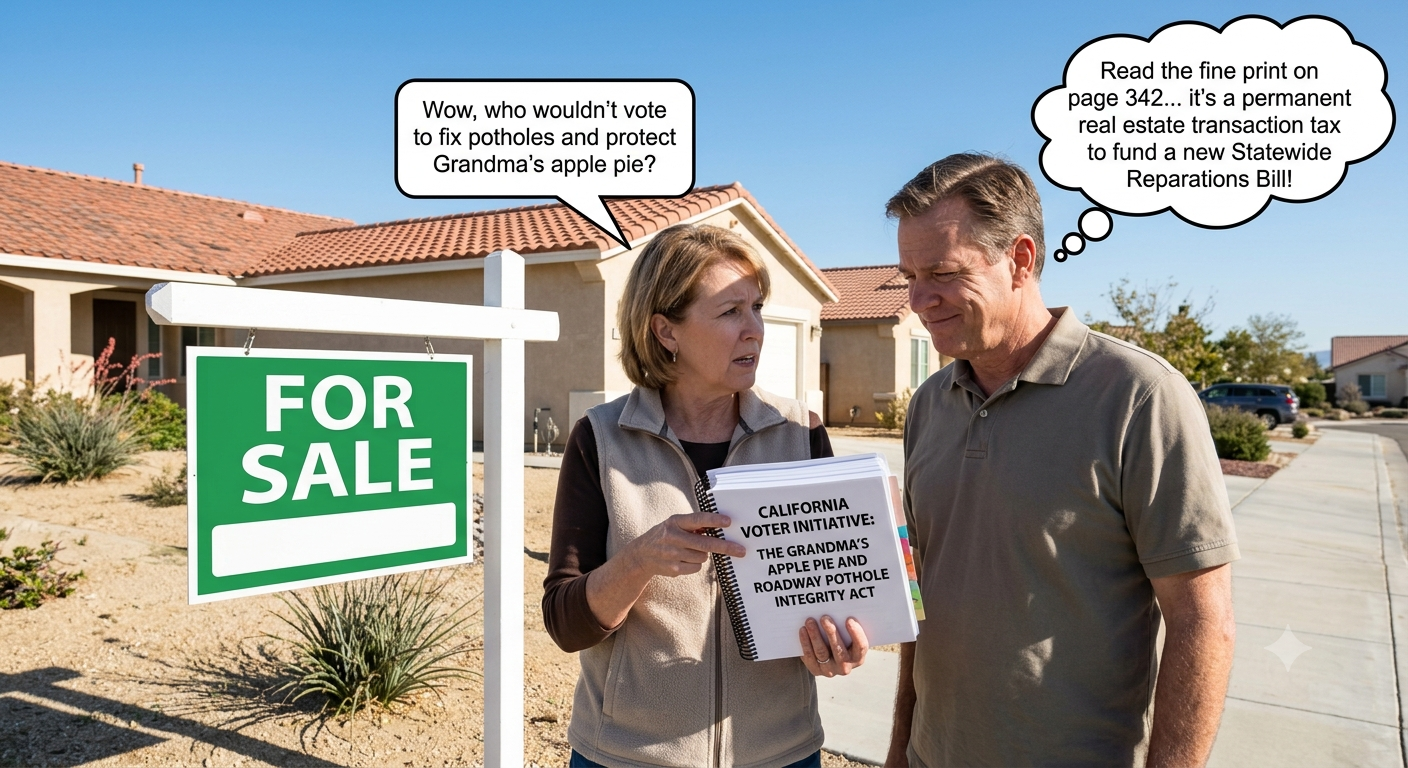
In Sacramento, no unpopular tax or multi-billion-dollar pet project is ever introduced by its real name. If a politician wants to empty your pockets, they don’t title the bill “Let’s Tax the Sale of Your Home to Fund a Bureaucracy.” No, it’s always wrapped in something wholesome, like The Grandma’s Apple Pie and Puppy Protection Act.
Pothole Repair Train to Nowhere
The Great Gas Tax Bait-and-Switch
We’ve seen this script play out before. Remember when the state pushed through a massive gas tax increase? It was sold to the public under the ultimate banner of common sense: “Let’s Fix the Structural Integrity of Our Roadways, Potholes, Bridges, and Overpasses to Withstand Earthquakes.” Who could possibly vote against safer bridges?
The fine print, of course, ensured the tax automatically goes up every single July 1st, by law, with absolutely no mechanism to ever let it go down. But the real magic happened when the ink dryly settled on the state budget. Buried deep within a hundreds-of-pages-long budget trailer bill, under a labyrinth of three-digit section numbers, an automatic escape clause gave the executive branch the power to shift billions.
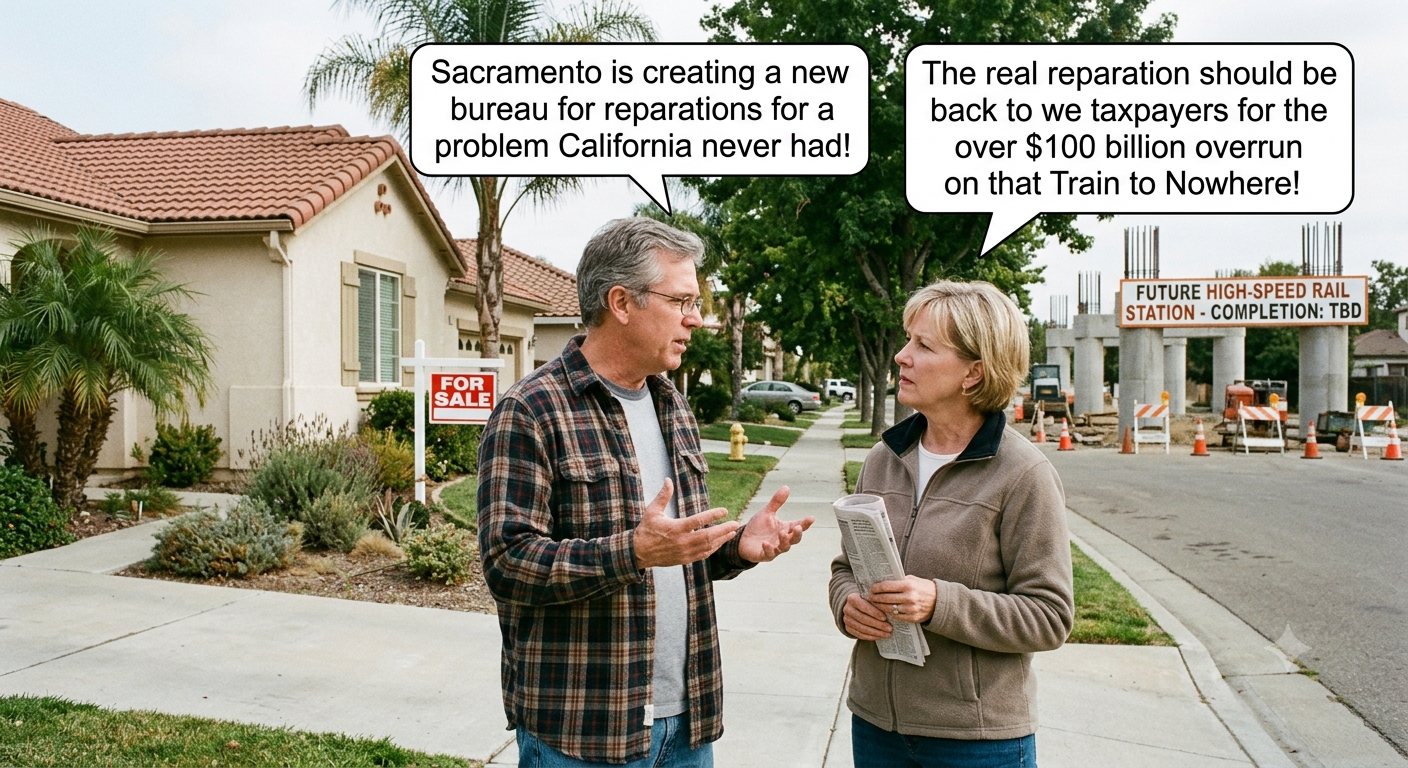
And just like that, funding explicitly promised to fix the tire-popping crater on your local freeway bypass was legally diverted to subsidize the Central Valley’s infamous, multi-billion-dollar “Train to Nowhere” boondoggle.If the ballot had honestly asked voters, “Would you like to pay $6 a gallon so we can finish a high-speed rail line that is 500% over budget?” the answer would have been a resounding no. But mask it as a bridge repair, and the cash flows freely.
The Next Frontier: Pre-Funding the Pipeline
Now, the exact same legislative playbook is being deployed to construct a state-level reparations system.Realizing that immediate, massive cash payouts would face immense public pushback in a state staring down structural budget deficits, Sacramento has quietly pivoted to building the regulatory “plumbing” first.
They have already chaptered SB 518 into law, officially creating the brand-new Bureau for Descendants of American Slavery. Millions of taxpayer dollars are already being allocated simply to set up this agency, hire state directors, and build a massive genealogical database to verify future eligibility.
They aren’t writing the giant checks just yet—they are just setting up the government apparatus so that when the right political window opens, the pipeline is fully built and ready to be turned on.
The Bottom Line for Homeowners and Buyers
When the final funding bills are pushed through to pay for this new bureau’s ultimate goals, they won’t be called tax hikes. They will likely look like a series of “Housing Equity Grants” or “Eminent Domain Redress Subsidies,” perhaps buried as a mandatory surcharge on real estate transactions or an adjustment to local property assessments.
We are already seeing the introductory bills, like AB 57, which aims to redirect portions of state housing funds specifically to targeted buyer subsidies.
For California homeowners and real estate investors, this ongoing political theater has real-world economic consequences. Every time a new bureau is built, or a tax is diverted under a hidden section number, the baseline cost of owning, buying, or selling a home in this state edges higher. Local governments will continually find new, creative ways to mandate fees at the closing table to fund these sweeping state-level social experiments.
In Case You Don’t Believe This Is Going To Happen: Here’s What’s Already On the Books (and What’s Next)
If you think a statewide reparations network is just theoretical Internet chatter that will never affect California real estate or local tax structures, you need to look at the official legislative docket in Sacramento. The state isn’t just debating the topic; they have been actively passing laws to construct the structural, administrative “plumbing” for the system.
Below is a look at the actual bills that have already been chaptered into law, alongside the “Road to Repair” legislative package moving through the pipeline to finalize the program:
Bill Number & Status
Wholesome Legislative Title
The Real-World Purpose & Bottom Line
SB 518
(Passed & Chaptered)
“An act relating to state government administration.”
The Bureau Setup: Officially establishes the Bureau for Descendants of American Slavery within the CA Department of Justice to build the claims registry.
SB 437
(Passed & Chaptered)
“California State University: research and reporting.”
The Eligibility Fingerprint: Allocates $6 million to the CSU system specifically to develop the scientific, genealogical methodology to verify claims.
AB 1714
(Active Session)
“Personal Income Tax Law: Gross Income Exclusions.”
The Tax Shelter: Pre-emptively changes state tax law to ensure any future reparations payouts or housing grants are completely exempt from state income tax.
AB 57
(Active Session)
“Home Purchase Assistance Program allocation.”
The Real Estate Siphon: Redirects a mandatory portion of state first-time homebuyer assistance funds exclusively to specific, targeted buyer demographics.
AB 62
(Active Session)
“Eminent domain: state property acquisition redress.”
The Property Clawback: Creates new, retroactive legal pathways to claim financial redress or land handbacks over historical local eminent domain actions.
AB 742
(Active Session)
“Business and professions: priority licensing.”
The Marketplace Advantage: Mandates that the state grant priority positioning and expedited processing when issuing professional state business licenses.
The Takeaway for Property Owners: The machinery is already built. Once these administrative bureaus, tax exemptions, and genealogical databases are fully operational, the state will only need a single funding mechanism to turn the spigot on. For property owners, that means keeping a very sharp eye out for hidden real estate transactional surcharges or property assessment adjustments buried in upcoming, innocently named omnibus budget bills. Based on past California legislative history, it seems almost assured that when this system is finally set up, the top bureaucrats in charge of managing it will themselves be earning well over half a million dollars in taxpayer-funded salary and benefits. Actual salaries and benefits from public audit records show exactly how this plays out across the state’s agencies: LA County Lifeguard Captains topping $510,000, executive management at the Metropolitan Water District of Southern California clearing over $520,000, the LA Fire Chief pushing beyond $630,000, and high-level California State Prison Physicians and Surgeons drawing down packages worth up to $605,000 annually.
The Real “Reparations Act” California Actually Needs
If Sacramento truly wants to introduce a fiscal remedy that benefits everyday citizens, it shouldn’t be building new bureaucratic pipelines; instead, it should pass a Reparations Act for the “Train to Nowhere.” When California voters approved Proposition 1A back in 2008, they authorized a specific $9.95 billion seed bond for an 800-mile high-speed rail line expected to be completely finished by 2020. Flash forward to today, and the projected cost for Phase 1 alone has ballooned by a staggering $100 billion over budget, reaching a total projected cost of over $120 billion.
Because billions of dollars have been quietly siphoned from your increased gas taxes and state cap-and-trade funds to cover this astronomical overrun, the state owes its residents a massive refund. A real, common-sense reparations package would mandate that every single California legislator and high-level state government worker take an immediate 10% salary and benefit reduction. This salary freeze would remain in place until the entire multi-billion-dollar cost overrun is fully refunded back to the taxpayers who have been stuck living in the state and paying for this historic government blunder. Now that is a legislative bill that would send a message heard loud and clear.
Pothole Repair Train to Nowhere
The “Train to Nowhere” Tax Refund Breakdown
Scenario A: Total Owner-Occupied Homes (Approx. 7.5 Million Homes) If the refund is strictly limited to Californians who own and live in their primary residence (single-family homes and owner-occupied condos):
Your Refund Check:~$13,333 per homeowner
Scenario B: Total Individual Residential Parcels (Approx. 10 Million Properties) If you expand the pool to include every single-family home, townhome, and individual condo unit in the state (including rental properties and second homes):
Your Refund Check:~$10,000 per property owner
Scenario C: Every Single Housing Unit in the State (Approx. 14 Million Units) Even if you went to the absolute maximum and counted every single piece of residential roof in the state—including individual apartments in large complexes:
The Refund Value:~$7,142 per unit
The Bottom Line
No matter which slice of the data you use, the state has effectively siphoned between $7,100 and $13,300 out of the pockets of every single California property owner to fund those historic cost overruns. Dropping a $10,000 credit onto a homeowner’s property tax bill would certainly go a long way in making up for years of creative Sacramento bookkeeping.
The next time you see a ballot measure promising to “beautify local medians,” look very closely at the bottom line. The curtain is pulled back, and it’s time to read the fine print with eyes wide open.
Pothole Repair Train to Nowhere
#######
Brokerforyou.com is for SALE
Just like most major businesses, the easiest way, and the fastest way to expand your business and influence in your particular market is through strategic acquisition. Just look at Google, they are the number one search engine in the world! Google bought Youtube in November 2006 for US$1.65 billion! YouTube now operates as one of Google’s subsidiaries.www.brokerforyou.com is for sale and is offered with a very popular San Diego residential real estate channel with 1.16K subscribers and 114 videos!!What’s the approximately monthly cost to host a website? With shared hosting, you’re hosting fee can break down to about 10 to $15 per month. To keep your url registered (that’s your site address), this is usually paid on a five to 10-year basis, which averages out to about just a dollar per month! Naturally, if you add direct hook-up to a MLS database, that provides lead capturing, this costs can vary greatly from provider-to-provider.
Also available, much smaller aged websites (not just urls) for Real Estate agents and brokers in California. Yes, since I’m retired from Real Estate now I have a number of websites that are available that you can use for readings to your main site. The following real estate area sites are available but subject to prior sale, without notice: San Diego, downtown San Diego, Del Mar, Encinitas, Orange County, and Los Angeles. If you’d like to purchase any of these sites with all the content included, you can get them at a Bargain Basement price. Please contact me if you’d like further details.
Interested, call Bob Schwartz (619) 286-5604 for additional information
Great 360 Camera – This is the one that I use not only for real estate but motorcycling & gold prospecting.
Direct from the manufacturer w/ Free shipping, special bonus accessory & even tax included.
Click camera photo below for more details and to see actual 360 video & photos taken with this amazing marvel, direct from manufacturer . . .
insta360 One X3
++++++++
DISCLAIMER:
Some of the links in this content and in our videos may be affiliate links, and pay a small commission if you use them, but never increase the basic cost. I really appreciate the support. This content & my Youtube videos SHALL NOT be construed as tax, legal, insurance, construction, engineering, health & safety, electrical, financial advice, or other & may be outdated or inaccurate; it is your responsibility to verify all information. I am a not financial adviser. I only express my opinions based on my experiences. Your experience may be quite different. Investing of any kind involves risk. While it is possible to minimize risk, your investments are solely your responsibility. You must conduct your own research. There is NO guarantee of gains or losses on any investments. My produced content & videos are for entertainment purposes ONLY. DO NOT make buying or selling decisions based on these videos. If you need advice, please contact a qualified CPA, attorney, insurance agent, contractor/electrician/engineer, financial advisor, or the appropriate professional for the subject you would like help with.
Although no longer a licensed California real estate broker Bob’s 30 plus years of experience in the real estate industry with all the contacts that he has developed, he is able to provide referrals to the top real estate Professionals in any state within the United States. So, although you can’t get Bob to represent you personally, Bob can select a top real estate professional with years and years of experience to ensure that you get the best possible representation.
We use cookies to ensure that we give you the best experience on our website. If you continue to use this site we will assume that you are happy with it.