Is California Prop 13 Under Attack? Unpacking ACA 1, ACA 13, and the Battle for Your Property Taxes
In California, Proposition 13 isn’t just a law; it’s a political cornerstone. Passed by voters in 1978, it established strict limits on property tax rates and assessment increases, providing a sense of stability for millions of homeowners and businesses.
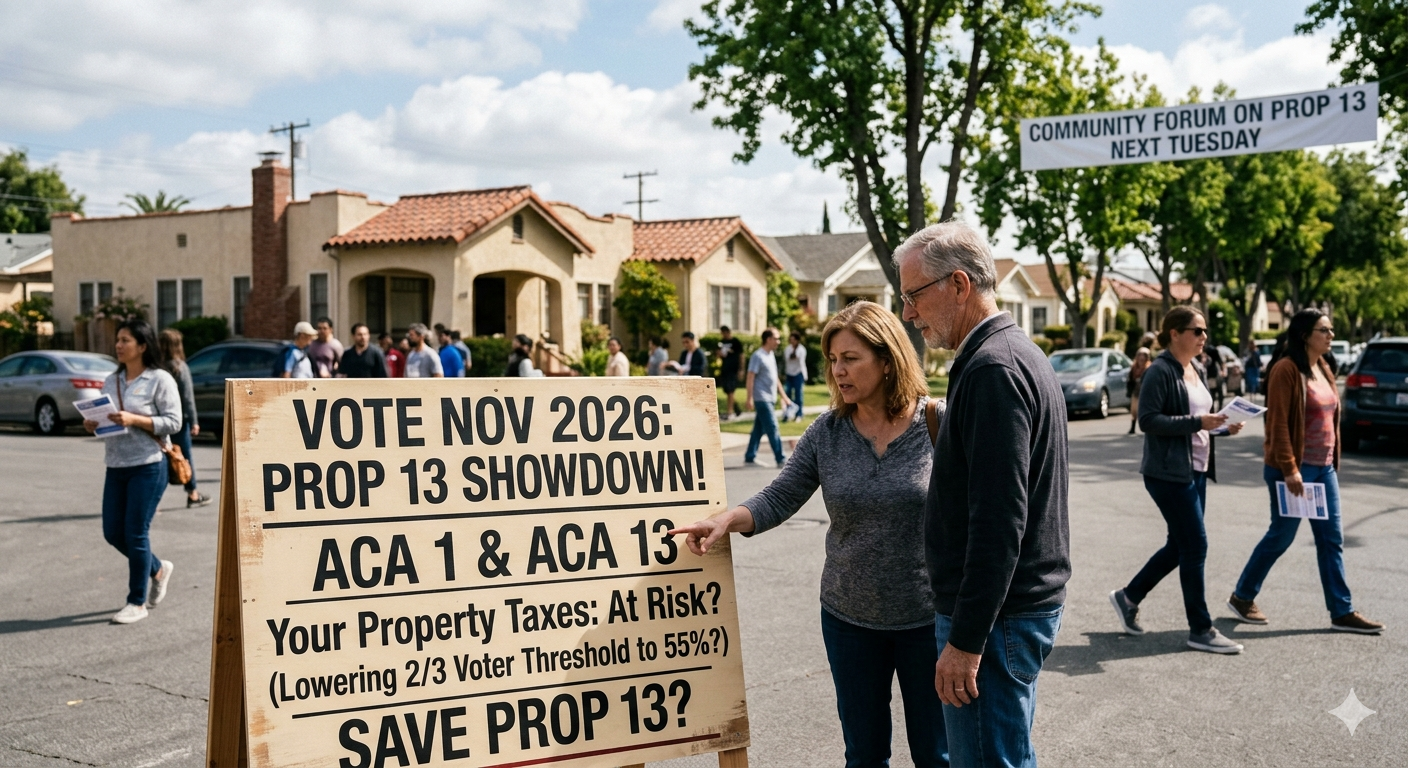
But as the cost of living in the Golden State continues to soar, new challenges to this landmark initiative have emerged. All eyes are now on the November 2026 ballot, where two competing visions for California’s tax system—ACA 1 and ACA 13—will be put before the voters.
Is California Prop 13 Under Attack?
If you are a property owner, or even if you are just concerned about the state’s fiscal future, understanding these measures is critical. The debate isn’t just about percentage points; it’s about the fundamental balance between government funding needs and taxpayer protections.
The Problem: Is it Funding or Spending?
There is no denying that California faces significant infrastructure challenges. From the desperate need for affordable housing to aging roads and transit systems, local governments argue they are starved of the funds necessary to build a modern state. They point to a crucial barrier established by Prop 13: a two-thirds (66.7%) supermajority vote required for most “special taxes” and local bonds.
However, many taxpayers see a different “problem.” Critics argue that before asking for more money, the state must address its own “wasteful and overspending” habits. California state workers are among the highest-paid in the country, and the state’s pension system—one of the most generous and expensive in the nation—carries massive unfunded liabilities. For many, the push for ACA 1 and ACA 13 isn’t about a lack of revenue, but a refusal to prioritize existing funds and reform a system that rewards bureaucracy over the average taxpayer.
ACA 1: A Shift in the Balance
Enter ACA 1 (Assembly Constitutional Amendment 1). Slated for the November 2026 ballot, ACA 1 directly tackles that two-thirds requirement.
What ACA 1 Proposes: ACA 1 seeks to lower the voting threshold to 55% for local bonds and special taxes dedicated to affordable housing, permanent supportive housing, and public infrastructure projects.
The Argument For: Supporters, including many affordable housing advocates and local labor unions, argue that this is a common-sense reform. A 55% threshold, they contend, still ensures significant broad support but prevents a minority (the 33.3%) from blocking projects a clear majority of the community wants. It would, they believe, unlock billions in funding to build housing for the homeless and middle class, create construction jobs, and revitalize neighborhoods.
The Argument Against: Critics, led by groups like the Howard Jarvis Taxpayers Association, sound the alarm. They see this threshold reduction as a profound erosion of Prop 13’s core defense mechanism. They argue that Prop 13 was designed to ensure that new tax burdens require overwhelming consensus. Lowering it to 55%, they warn, will make it vastly easier for local governments to pass new taxes and bonds.
The Backdoor Argument: What it Means for Your Tax Bill
But will ACA 1 actually end Prop 13? Technically, no.
The core tenets of Prop 13—the 1% cap on the property tax rate and the 2% annual limit on assessment increases—would remain in place. However, the practical effect is where the controversy lies.
Taxpayer advocates argue that ACA 1 creates a “backdoor” to higher property taxes. While the base rate stays the same, homeowners often pay additional “voter-approved debt” (bonds and assessments) on their tax bills. By making it easier (at 55%) to pass these extra charges, the total property tax bill could increase substantially.
A 1% base tax might stay the same, but the total tax bill, once those easier-to-pass bonds are added, could look very different.
ACA 13: The Chess Move
As if ACA 1 wasn’t complex enough, the California Legislature introduced ACA 13, also on the November 2026 ballot. This is often viewed as a direct counter-maneuver to another initiative designed to strengthen Prop 13.
What ACA 13 Proposes: It would require that any future ballot initiative that proposes to raise a voting threshold (e.g., from a majority to 2/3) must itself pass by that exact same supermajority.
The Argument For: Proponents of ACA 13 argue this is a matter of fairness and consistency. If you want to require a 2/3 vote to pass a law, the law requiring that 2/3 vote should also command 2/3 support from the voters. It aims to prevent a narrow majority (50% + 1) from enacting permanent supermajority requirements for future policy.
The Argument Against: This is widely seen as a shot across the bow of the “Taxpayer Protection and Government Accountability Act” (TPA), an initiative gathering signatures for a separate ballot. The TPA wants to constitutionally lock-in Prop 13’s supermajority requirements. ACA 13 would make it far harder for the TPA to pass. Taxpayer groups accuse the legislature of playing procedural games to make it nearly impossible for the public to constitutionally defend Prop 13 protections through the initiative process.
The Showdown of 2026
The November 2026 ballot will be a true battleground for California’s fiscal soul. Voters will be asked:
Should we make it easier (55%) to fund affordable housing and infrastructure? (ACA 1)
Should we change the rules for how supermajority requirements themselves are passed? (ACA 13)
It’s important to note that a separate, grassroots counter-movement called “Save Prop 13” has already turned in over 1.3 million signatures to qualify for the same ballot, aiming to solidify Prop 13 protections.
These issues are complex and interconnected, and the stakes for California property owners could not be higher. Does the need for infrastructure justify weakening a decades-old taxpayer defense? Or are these measures a necessary modernization for a state facing an unprecedented housing crisis? This November 2026, California will decide.
Is California Prop 13 Under Attack?
#######
Brokerforyou.com is for SALE
- Just like most major businesses, the easiest way, and the fastest way to expand your business and influence in your particular market is through strategic acquisition. Just look at Google, they are the number one search engine in the world! Google bought Youtube in November 2006 for US$1.65 billion! YouTube now operates as one of Google’s subsidiaries.www.brokerforyou.com is for sale and is offered with a very popular San Diego residential real estate channel with 1.16K subscribers and 114 videos!!What’s the approximately monthly cost to host a website? With shared hosting, you’re hosting fee can break down to about 10 to $15 per month. To keep your url registered (that’s your site address), this is usually paid on a five to 10-year basis, which averages out to about just a dollar per month! Naturally, if you add direct hook-up to a MLS database, that provides lead capturing, this costs can vary greatly from provider-to-provider.
- Also available, much smaller aged websites (not just urls) for Real Estate agents and brokers in California. Yes, since I’m retired from Real Estate now I have a number of websites that are available that you can use for readings to your main site. The following real estate area sites are available but subject to prior sale, without notice: San Diego, downtown San Diego, Del Mar, Encinitas, Orange County, and Los Angeles. If you’d like to purchase any of these sites with all the content included, you can get them at a Bargain Basement price. Please contact me if you’d like further details.
- Interested, call Bob Schwartz (619) 286-5604 for additional information
Looking for a real unique gift/Investment?
Natural gold nuggets

Natural gold nugget Visit our California & Arizona gold prospecting site.
+++++++++++++
Great 360 Camera – This is the one that I use not only for real estate but motorcycling & gold prospecting.
Direct from the manufacturer w/ Free shipping, special bonus accessory & even tax included.
Click camera photo below for more details and to see actual 360 video & photos taken with this amazing marvel, direct from manufacturer . . .

- insta360 One X3
++++++++
DISCLAIMER:
- Some of the links in this content and in our videos may be affiliate links, and pay a small commission if you use them, but never increase the basic cost. I really appreciate the support. This content & my Youtube videos SHALL NOT be construed as tax, legal, insurance, construction, engineering, health & safety, electrical, financial advice, or other & may be outdated or inaccurate; it is your responsibility to verify all information. I am a not financial adviser. I only express my opinions based on my experiences. Your experience may be quite different. Investing of any kind involves risk. While it is possible to minimize risk, your investments are solely your responsibility. You must conduct your own research. There is NO guarantee of gains or losses on any investments. My produced content & videos are for entertainment purposes ONLY. DO NOT make buying or selling decisions based on these videos. If you need advice, please contact a qualified CPA, attorney, insurance agent, contractor/electrician/engineer, financial advisor, or the appropriate professional for the subject you would like help with.
- Although no longer a licensed California real estate broker Bob’s 30 plus years of experience in the real estate industry with all the contacts that he has developed, he is able to provide referrals to the top real estate Professionals in any state within the United States. So, although you can’t get Bob to represent you personally, Bob can select a top real estate professional with years and years of experience to ensure that you get the best possible representation.