The Hidden Cost of Selling a California Home
The Reality of Modern Real Estate Regulation
For decades, selling a home followed a predictable playbook: you hired an agent, decluttered the kitchen, touched up the paint, and waited for the offers to roll in. But if you own a home or a duplex in Berkeley, California, that era is officially over.
Effective January 1, 2026, a sweeping update to the city’s Building Emissions Saving Ordinance (BESO) has transformed routine real estate transactions into a high-stakes bureaucratic obstacle course. Under the banner of environmental progress, the local government has locked down the housing market with a closed, gatekept system of mandates that many local property owners are calling pure, unadulterated socialism.
The Hidden Cost of Selling a California Home
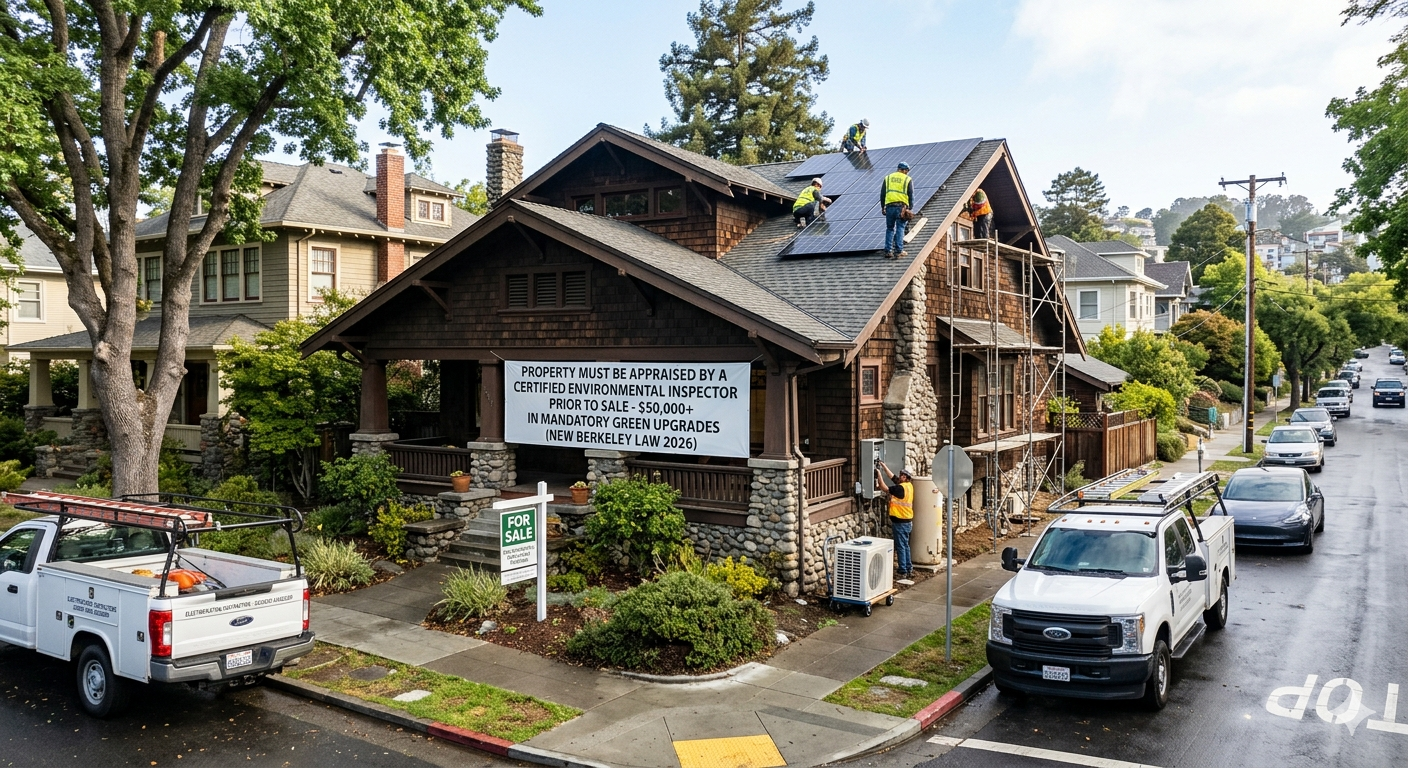
By stripping citizens of their basic right to buy and sell private property freely, the city is forcing residents to jump through massive monetary hoops just to unlock their own home equity. If you are planning to list a property in the East Bay, you can no longer simply transact with a willing buyer. First, you must pay the city’s approved network for permission—and you may be forced to spend up to $50,000 on government-mandated green upgrades before a single dollar changes hands.
Phase 1: The Closed System of Mandatory Inspections
The new law takes aim at the very beginning of the sales pipeline. Before a seller can legally list a single-family home or duplex on the public market or place it in the Multiple Listing Service (MLS), they are hit with a pre-listing requirement.
Property owners are legally forced to hire a certified Registered BESO Assessor to conduct a comprehensive Home Energy Score (HES) evaluation. This is not a standard, independent home inspection meant to protect a buyer’s safety; it is a specialized environmental audit that grades your home’s private energy efficiency on a rigid, state-mandated 1-to-10 scale.
Because the city restricts these audits to a tightly gatekept registry of private contractors holding highly specific state and green-building credentials, property owners have a completely captive audience. Sellers must pay between $400 and $600 out-of-pocket just for the two-hour on-site inspection, plus an additional $150 administrative filing fee paid directly to the City of Berkeley just to process the paperwork.
The penalty for non-compliance? If a real estate agent lists a home without this government score proudly displayed in the public MLS remarks for all to see, the city slaps the transaction with an immediate $500 fine.
Phase 2: The Menu of Forced Upgrades (The True Financial Hit)
Receiving your 1-to-10 score is just the starting line. The core of the 2026 mandate requires that the home achieve a minimum of 6 compliance credits via physical environmental and electrification upgrades before the city will grant a final Certificate of Compliance allowing the sale to close.
The city offers a menu-style system to earn these credits, but the real-world execution reveals a staggering financial trap for owners of historic or older homes. Look at the estimated costs to hit that mandatory 6-credit threshold:
Electric Heat Pump Water Heater (6 Credits): $4,000 – $8,000
Electric Heat Pump HVAC System (6 Credits): $12,000 – $25,000+
Main Electrical Panel Upgrade (6 Credits): $4,000 – $8,000
Knob & Tube Wiring Replacement (6 Credits): $15,000 – $40,000+
Solar PV System (3 Credits): $15,000 – $25,000
Electric Vehicle (EV) Charger (2 Credits): $1,500 – $3,000
Where the $50,000 Figure Comes From
Proponents of the law argue that dropping in an energy-efficient water heater is a simple fix. However, Berkeley’s housing stock is famously historic.
If you own an older home with an antique 60-amp or 100-amp electrical service, you cannot safely plug in a modern electric heat pump or whole-house HVAC system without overloading the grid. To comply with the law, you are forced to first rip out your vintage knob-and-tube wiring, pay thousands to upgrade to a modern 200-amp smart electrical panel, and then install the green appliances. When combined, this government-mandated renovation chain easily rockets past $50,000 in mandatory out-of-pocket expenses.
Phase 3: The Escrow Loophole and Deferral Options
Recognizing that forcing working-class families to spend $30,000 to $50,000 on a home overhaul before they can unlock their equity would completely paralyze the local housing market, the city created a temporary pressure valve known as the Deferral Option.
If a seller cannot or will not perform the physical upgrades before closing, the legal obligation can be transferred entirely to the buyer through a strict escrow mechanism:
The $5,000 Escrow Holdback: Both the buyer and the seller are forced to deposit $2,500 each ($5,000 total cash) into a designated escrow account held by the City of Berkeley at closing.
The 2-Year Clock: The sale closes, and the buyer takes ownership of the home. The buyer then has a strict two-year deadline to complete the necessary 6-credit upgrades, pull the proper municipal building permits, and pass a final city inspection.
The Refund or Forfeit: If the buyer completes the work on time, the city returns the $5,000 deposit. If the buyer misses the deadline or refuses to comply, the government permanently forfeits the cash.
Real Estate and the Globalist “Own Nothing” Blueprint
To understand the long-term danger of these policies, one has to look at the broader, systemic shift occurring in property ownership. Critics point out that point-of-sale traps like Berkeley’s BESO align seamlessly with the infamous concept popularized via the World Economic Forum (WEF): “You’ll own nothing, and you’ll be happy.”
While globalist organizations frame this as a utopian, service-based future where individual burdens are eliminated, the practical mechanism to get there relies on slowly eroding the financial viability of private property rights. When a city government commands the authority to alter building mandates at whim, your equity is no longer truly yours; it becomes a moving target.
Consider a buyer purchasing a home today. They invest tens of thousands of dollars to achieve full compliance and secure their hard-earned city certificate. Yet, because these regulations are controlled entirely by changing municipal guidelines and city council votes, that compliance is purely temporary.
If that buyer tries to sell the home 5 or 10 years from now, the goalposts will have inevitably shifted. The required credit threshold may jump from 6 to 10, older solar technologies may be disqualified, or total gas-line capped removals may become mandatory. Concurrently, monopoly-driven inspector certification costs and filing fees will continue to escalate.
By trapping citizens in an endless, compounding cycle of point-of-sale penalties, governments make private homeownership so cost-prohibitive and heavily regulated that individual wealth accumulation slows to a crawl. The ultimate outcome is a slow squeeze that forces independent mom-and-pop owners out of the market entirely, leaving real estate to be bought up by institutional corporate landlords—forcing the average citizen into a permanent, government-managed tenant class.
Coming to a City Near You: The Looming Statewide Expansion
Many property owners look at Berkeley and think, “That’s just a radical university town; it won’t happen in my backyard.” Unfortunately, the financial reality of California municipalities suggests otherwise.
Faced with massive budget deficits, crumbling infrastructure liabilities, and skyrocketing localized costs, cities across the state are aggressively hunting for new ways to generate revenue and enforce compliance without passing highly unpopular, broad-based property tax hikes. This point-of-sale mandate provides them with the perfect, stealthy vehicle.
By forcing private property sellers to fund the upgrade of the municipal electrical grid and housing stock out of their own equity, local governments successfully offload their environmental infrastructure costs directly onto individual citizens. Furthermore, the continuous flow of mandatory inspection fees, city filing fees, and hefty non-compliance fines represents a massive, predictable new revenue stream for municipal building departments.
With California’s newly enacted state laws—like AB 39 (the Local Electrification Planning Act)—the legal framework for expansion is already built into the system.
How long before this spreads? Housing policy experts predict a rapid domino effect over the next 2 to 4 years. Progressive strongholds like San Francisco, Oakland, San Jose, and Santa Monica are already actively studying Berkeley’s BESO model as a blueprint. As these initial cities successfully implement the point-of-sale trap to boost local economic activity for green contractors and pad city administrative budgets, cash-strapped suburban municipalities will rapidly jump on board.
The Economic Fallout for Property Owners
While condos and all-electric homes with entirely capped gas lines are currently exempt from the upgrade rules, standard single-family residential properties are feeling the heat.
This law completely shifts the balance of power at the negotiation table. Savvy buyers are looking past the initial list price and aggressively calculating the “hidden BESO tax” waiting for them after closing. If a property requires extensive electrical overhauls, buyers are factoring that future debt directly into their initial numbers, heavily discounting their purchase offers to offset the incoming post-sale renovation bills.
Ultimately, Berkeley’s new point-of-sale law represents a chilling expansion of municipal authority over private real estate. By forcing private citizens to act as the primary funding mechanism for city-wide infrastructure goals under penalty of law, it has fundamentally threatened the very definition of private property rights in California.
The Hidden Cost of Selling a California Home
Disclaimer: The views and opinions expressed in this article are solely those of the author and are intended for informational and entertainment purposes only. This content does not constitute professional legal, financial, tax, or real estate advice. Because real estate laws and tax codes change rapidly, you should always consult with your own qualified attorney, CPA, and licensed real estate professionals before making any financial or investment decisions.
#######
Brokerforyou.com is for SALE
- Just like most major businesses, the easiest way, and the fastest way to expand your business and influence in your particular market is through strategic acquisition. Just look at Google, they are the number one search engine in the world! Google bought Youtube in November 2006 for US$1.65 billion! YouTube now operates as one of Google’s subsidiaries.www.brokerforyou.com is for sale and is offered with a very popular San Diego residential real estate channel with 1.16K subscribers and 114 videos!!What’s the approximately monthly cost to host a website? With shared hosting, you’re hosting fee can break down to about 10 to $15 per month. To keep your url registered (that’s your site address), this is usually paid on a five to 10-year basis, which averages out to about just a dollar per month! Naturally, if you add direct hook-up to a MLS database, that provides lead capturing, this costs can vary greatly from provider-to-provider.
- Also available, much smaller aged websites (not just urls) for Real Estate agents and brokers in California. Yes, since I’m retired from Real Estate now I have a number of websites that are available that you can use for readings to your main site. The following real estate area sites are available but subject to prior sale, without notice: San Diego, downtown San Diego, Del Mar, Encinitas, Orange County, and Los Angeles. If you’d like to purchase any of these sites with all the content included, you can get them at a Bargain Basement price. Please contact me if you’d like further details.
- Interested, call Bob Schwartz (619) 286-5604 for additional information
Looking for a real unique gift/Investment?
Natural gold nuggets

Natural gold nugget Visit our California & Arizona gold prospecting site.
+++++++++++++
Great 360 Camera – This is the one that I use not only for real estate but motorcycling & gold prospecting.
Direct from the manufacturer w/ Free shipping, special bonus accessory & even tax included.
Click camera photo below for more details and to see actual 360 video & photos taken with this amazing marvel, direct from manufacturer . . .

- insta360 One X3
++++++++
DISCLAIMER:
- Some of the links in this content and in our videos may be affiliate links, and pay a small commission if you use them, but never increase the basic cost. I really appreciate the support. This content & my Youtube videos SHALL NOT be construed as tax, legal, insurance, construction, engineering, health & safety, electrical, financial advice, or other & may be outdated or inaccurate; it is your responsibility to verify all information. I am a not financial adviser. I only express my opinions based on my experiences. Your experience may be quite different. Investing of any kind involves risk. While it is possible to minimize risk, your investments are solely your responsibility. You must conduct your own research. There is NO guarantee of gains or losses on any investments. My produced content & videos are for entertainment purposes ONLY. DO NOT make buying or selling decisions based on these videos. If you need advice, please contact a qualified CPA, attorney, insurance agent, contractor/electrician/engineer, financial advisor, or the appropriate professional for the subject you would like help with.
- Although no longer a licensed California real estate broker Bob’s 30 plus years of experience in the real estate industry with all the contacts that he has developed, he is able to provide referrals to the top real estate Professionals in any state within the United States. So, although you can’t get Bob to represent you personally, Bob can select a top real estate professional with years and years of experience to ensure that you get the best possible representation.