Will San Diego Real Estate Taxes Skyrocket 5,000%?
The Deceptive Ballot Tricks Taxing Californians Into Oblivion.
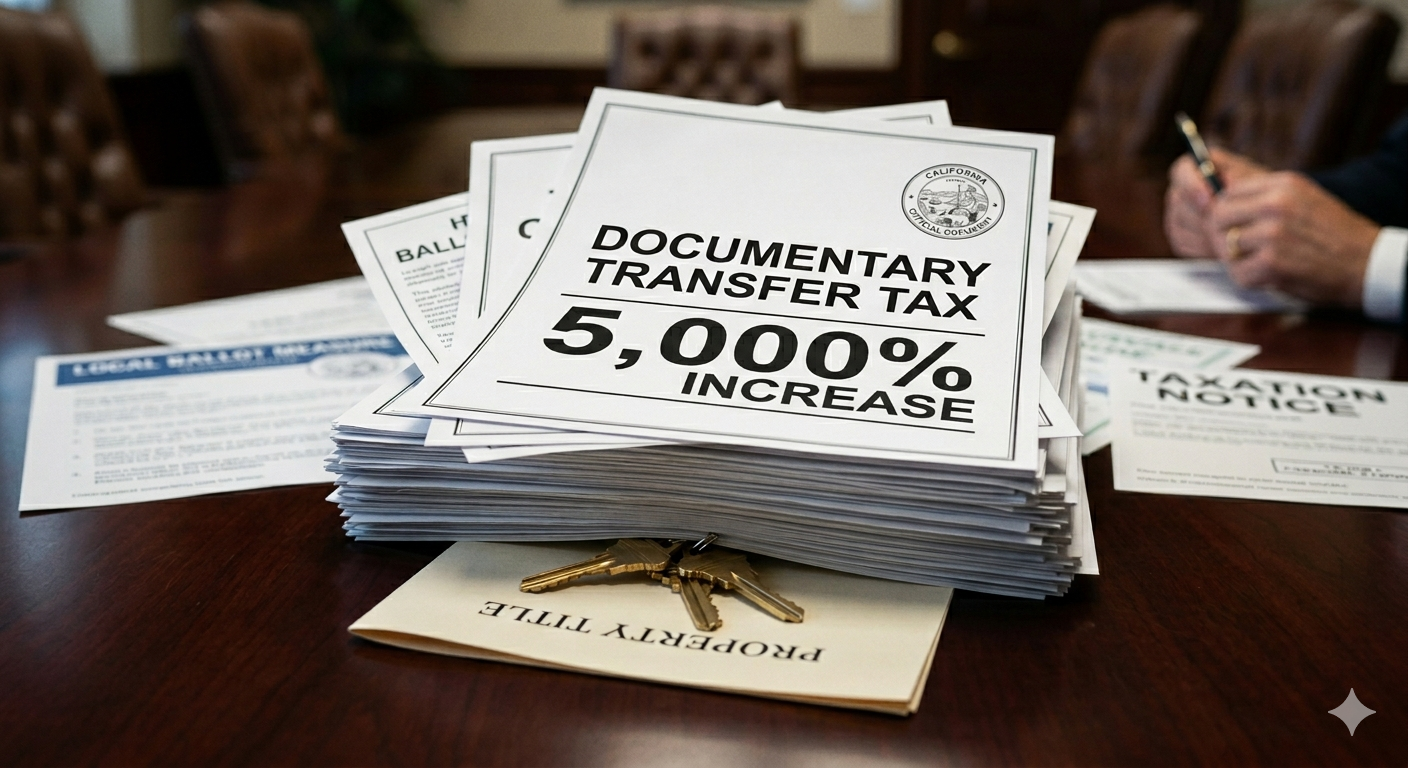
Anyone who has lived in California long enough knows the drill when election season rolls around. You open up your voter guide, read a beautifully worded ballot initiative that promises to “protect local communities” or “fund vital services,” and think it sounds perfectly reasonable.
But if you pull back the curtain and look at the fine print, you find out it’s actually a massive, wallet-shredding tax increase.
Will San Diego Real Estate Taxes Skyrocket 5,000%?
Right now, a major battle is brewing in Southern California that puts this exact dynamic on full display. Progressive leaders on the San Diego County Board of Supervisors are pushing a proposal to hike the real estate transfer tax on high-value properties by a staggering 5,000%.
The real story, however, isn’t just this jaw-dropping property tax spike—it’s the systematic, historical way the state’s political machine relies on voter naiveté and legal loopholes to trick citizens into voting themselves into financial oblivion.
The Math: From $1,100 to $60,000+ at Closing
To understand how radical this proposal is, you have to look at how real estate transactions are currently taxed. The baseline California state transfer tax is set at a modest $1.10 for every $1,000 of a property’s sale price.
The Status Quo: If you sell a commercial building, an apartment complex, or a piece of land valued at $1 Million, your baseline transfer tax at closing is exactly $1,100.
The Proposed Jump: The new proposal seeks to jack that rate up from $1.10 per $1,000 all the way to $61.10 per $1,000.
The New Reality: Under this 5,000% rate explosion, that exact same $1,100 tax bill instantly turns into a devastating $60,000+ cash requirement due the moment the deed transfers.
While proponents pitch this as a “mansion tax” targeting only the ultra-wealthy, it hits commercial strip malls, grocery stores, and multi-family apartment complexes the hardest. When it costs an extra $60,000 to sell a local commercial structure, that cost gets passed directly down to everyday citizens via higher rents and higher consumer prices.
We already have a roadmap of how this disaster plays out. When Los Angeles passed a similar “Mansion Tax” (Measure ULA), high-value commercial transactions plummeted by 78%, freezing development and actually costing the city vital property tax reassessment revenue.
The “Millionaire” Bait: Lowering the Threshold by Decree
Proponents of these massive transaction fees always lead with the exact same marketing pitch: “Don’t worry, this only hits the multi-millionaires, billionaires, and giant corporate entities. The average citizen won’t pay a dime.” It is a highly effective way to lull the public into a false sense of security.
But history and the reality of the tax code show us that once the bureaucratic infrastructure of a new tax is safely bolted into place, politicians don’t need to pass a brand-new law to catch everyone else—they just slowly lower the bar. Under standard municipal and county tax codes, altering the exemption thresholds or adjusting definitions doesn’t always require a fresh, high-profile vote of the people. Instead, a local legislature or city council can quietly move the goalposts under the guise of “budgetary emergencies” or “inflationary adjustments” to close standard deficits.
We have seen this blueprint play out nationally with the federal income tax—which originally began in 1913 as a tiny 1% levy targeting exclusively the ultra-wealthy, only to quickly encompass the entire working class. More recently, look at how local municipal “vacant home taxes” and luxury parcel fees across California are initially sold as narrow penalties on corporate speculators, only for local councils to aggressively attempt to lower exemptions or raise flat rates the second a fiscal year ends in the red. Once the trap is built, extending it to the rest of the populace is just a matter of administrative paperwork.
The Gas Tax Blueprint: A Masterclass in the “Bait-and-Switch”
If you think politicians wouldn’t dare use public funds as a shell game, look no further than California’s notorious gas tax framework.
When Sacramento aggressively pushed for the massive Senate Bill 1 (SB 1) gas tax increases, the pitch to naive voters was straightforward and emotionally loaded: The money will go exclusively to repairing crumbling roads, fixing lethal potholes, and earthquake-proofing vulnerable bridges. To ensure the revenue keeps compounding, a mechanism was built directly into the law ensuring the tax automatically increases every single July 1st—a one-way ratchet that can legally go up or stay flat, but can never go down.
Trusting the pitch, voters let it pass. But the structural deception was already baked into the cake.
Just a couple of years later, Governor Gavin Newsom pulled back the curtain on the ultimate bait-and-switch. Utilizing pre-built climate mandates and regulatory loopholes embedded within the state’s transportation framework (crystallized by measures like Executive Order N-19-19), the administration actively began redirecting hundreds of millions of dollars away from critical highway expansions and local road repairs.
Where did that money go instead? It was funneled directly into propping up the state’s heavily delayed, multi-billion-dollar High-Speed Rail project—the infamous “Train to Nowhere.” Local highway safety projects, such as vital lane expansions on Central Valley freeways, were abruptly canceled or frozen so the money could feed a transit system that independent audits show is nowhere near functional.
The “Crooked” Ballot Name Game
How do politicians continuously pull off these maneuvers? They weaponize the very language printed on your ballot.
For decades, everyday Californians have noticed that ballot measures are frequently named the exact opposite of what they actually do. The controversy over these rigged titles grew so loud that the state originally appointed the California Attorney General to act as an independent party responsible for writing “true and impartial” titles.
Instead, handing that power to Sacramento had the reverse effect—it completely politicized the process.
Because the Attorney General is a partisan, elected politician, the official titles are routinely engineered to shield tax hikes and tank taxpayer revolts:
The Gas Tax Shield: When furious taxpayers successfully qualified a ballot measure to repeal the gas tax hike, the Attorney General’s office aggressively scrubbed the words “repeal” and “gas tax” from the main heading. Instead, they officially labeled it: “Eliminates Certain Road Repair and Transportation Funding.” Voters entered the booth genuinely believing they were cutting emergency safety funds rather than lowering their own cost of living.
The Prop 13 Attack: When an initiative was launched to dismantle key parts of California’s iconic Proposition 13 property tax protections for commercial structures, the Attorney General labeled it as a measure that “Increases Funding for Public Schools and Local Government Services.” It completely buried the fact that it was achieving that funding via a historic $12 billion property tax hike.
The Residential Pivot: How Homes Get Caught in the Net
The current San Diego transfer tax proposal is being publicly debated primarily through the lens of commercial real estate and multi-million dollar transactions. But a fundamental rule of governance is that a tax framework is highly fungible. If the county successfully establishes a mechanism that allows a real estate transfer tax to jump up to 6.11%, the structural boundary between a “commercial” deed transfer and a “residential” deed transfer becomes incredibly fragile.
If a future economic downturn hits and commercial tax revenues dry up—which is exactly what happened in Los Angeles when their “Mansion Tax” caused high-value deals to plummet—the local government will face a massive revenue shortfall. To fix it, the legislature can simply redefine what constitutes an “applicable transfer.” Without ever putting a new tax measure on a public ballot, politicians could expand the tax code’s definitions, quietly dragging standard single-family residential homes directly into the 5,000% penalty bracket. An average family looking to downsize or relocate for work would find themselves trapped by a closing fee originally meant for high-rise commercial developers.
When Will Californians Wake Up?
The upcoming San Diego transfer tax fight is just the latest chapter in a long history of political illusions. Proponents will wrap this 5,000% real estate tax spike in a beautiful, altruistic bow, and state lawyers will draft a ballot title designed to pull the wool over the public’s eyes one more time.
Californians consistently look at their monthly bills, their gas prices, and their housing costs and wonder why it has become so impossibly expensive to survive on the West Coast. The answer is staring them right back in the face in the mirror. Until voters stop buying the deception, look past the slick titles, and start aggressively voting down these stealth cash grabs, they will continue to watch themselves get hoodwinked straight into financial oblivion.
Will San Diego Real Estate Taxes Skyrocket 5,000%?
#######
Brokerforyou.com is for SALE
- Just like most major businesses, the easiest way, and the fastest way to expand your business and influence in your particular market is through strategic acquisition. Just look at Google, they are the number one search engine in the world! Google bought Youtube in November 2006 for US$1.65 billion! YouTube now operates as one of Google’s subsidiaries.www.brokerforyou.com is for sale and is offered with a very popular San Diego residential real estate channel with 1.16K subscribers and 114 videos!!What’s the approximately monthly cost to host a website? With shared hosting, you’re hosting fee can break down to about 10 to $15 per month. To keep your url registered (that’s your site address), this is usually paid on a five to 10-year basis, which averages out to about just a dollar per month! Naturally, if you add direct hook-up to a MLS database, that provides lead capturing, this costs can vary greatly from provider-to-provider.
- Also available, much smaller aged websites (not just urls) for Real Estate agents and brokers in California. Yes, since I’m retired from Real Estate now I have a number of websites that are available that you can use for readings to your main site. The following real estate area sites are available but subject to prior sale, without notice: San Diego, downtown San Diego, Del Mar, Encinitas, Orange County, and Los Angeles. If you’d like to purchase any of these sites with all the content included, you can get them at a Bargain Basement price. Please contact me if you’d like further details.
- Interested, call Bob Schwartz (619) 286-5604 for additional information
Looking for a real unique gift/Investment?
Natural gold nuggets

Natural gold nugget Visit our California & Arizona gold prospecting site.
+++++++++++++
Great 360 Camera – This is the one that I use not only for real estate but motorcycling & gold prospecting.
Direct from the manufacturer w/ Free shipping, special bonus accessory & even tax included.
Click camera photo below for more details and to see actual 360 video & photos taken with this amazing marvel, direct from manufacturer . . .

- insta360 One X3
++++++++
DISCLAIMER:
- Some of the links in this content and in our videos may be affiliate links, and pay a small commission if you use them, but never increase the basic cost. I really appreciate the support. This content & my Youtube videos SHALL NOT be construed as tax, legal, insurance, construction, engineering, health & safety, electrical, financial advice, or other & may be outdated or inaccurate; it is your responsibility to verify all information. I am a not financial adviser. I only express my opinions based on my experiences. Your experience may be quite different. Investing of any kind involves risk. While it is possible to minimize risk, your investments are solely your responsibility. You must conduct your own research. There is NO guarantee of gains or losses on any investments. My produced content & videos are for entertainment purposes ONLY. DO NOT make buying or selling decisions based on these videos. If you need advice, please contact a qualified CPA, attorney, insurance agent, contractor/electrician/engineer, financial advisor, or the appropriate professional for the subject you would like help with.
- Although no longer a licensed California real estate broker Bob’s 30 plus years of experience in the real estate industry with all the contacts that he has developed, he is able to provide referrals to the top real estate Professionals in any state within the United States. So, although you can’t get Bob to represent you personally, Bob can select a top real estate professional with years and years of experience to ensure that you get the best possible representation.